 Add to Chrome
 Add to Firefox
 Add to Edge
knowledge graph neo4j
Papers and Code
AI Co-Scientist for Knowledge Synthesis in Medical Contexts: A Proof of Concept
Jan 16, 2026
Research waste in biomedical science is driven by redundant studies, incomplete reporting, and the limited scalability of traditional evidence synthesis workflows. We present an AI co-scientist for scalable and transparent knowledge synthesis based on explicit formalization of Population, Intervention, Comparator, Outcome, and Study design (PICOS). The platform integrates relational storage, vector-based semantic retrieval, and a Neo4j knowledge graph. Evaluation was conducted on dementia-sport and non-communicable disease corpora. Automated PICOS compliance and study design classification from titles and abstracts were performed using a Bidirectional Long Short-Term Memory baseline and a transformer-based multi-task classifier fine-tuned from PubMedBERT. Full-text synthesis employed retrieval-augmented generation with hybrid vector and graph retrieval, while BERTopic was used to identify thematic structure, redundancy, and evidence gaps. The transformer model achieved 95.7% accuracy for study design classification with strong agreement against expert annotations, while the Bi-LSTM achieved 87% accuracy for PICOS compliance detection. Retrieval-augmented generation outperformed non-retrieval generation for queries requiring structured constraints, cross-study integration, and graph-based reasoning, whereas non-retrieval approaches remained competitive for high-level summaries. Topic modeling revealed substantial thematic redundancy and identified underexplored research areas. These results demonstrate that PICOS-aware and explainable natural language processing can improve the scalability, transparency, and efficiency of evidence synthesis. The proposed architecture is domain-agnostic and offers a practical framework for reducing research waste across biomedical disciplines.

Unlocking Advanced Graph Machine Learning Insights through Knowledge Completion on Neo4j Graph Database
Nov 14, 2025Graph Machine Learning (GML) with Graph Databases (GDBs) has gained significant relevance in recent years, due to its ability to handle complex interconnected data and apply ML techniques using Graph Data Science (GDS). However, a critical gap exists in the current way GDB-GML applications analyze data, especially in terms of Knowledge Completion (KC) in Knowledge Graphs (KGs). In particular, current architectures ignore KC, working on datasets that appear incomplete or fragmented, despite they actually contain valuable hidden knowledge. This limitation may cause wrong interpretations when these data are used as input for GML models. This paper proposes an innovative architecture that integrates a KC phase into GDB-GML applications, demonstrating how revealing hidden knowledge can heavily impact datasets' behavior and metrics. For this purpose, we introduce scalable transitive relationships, which are links that propagate information over the network and modelled by a decay function, allowing a deterministic knowledge flows across multiple nodes. Experimental results demonstrate that our intuition radically reshapes both topology and overall dataset dynamics, underscoring the need for this new GDB-GML architecture to produce better models and unlock the full potential of graph-based data analysis.
Generating Reliable Adverse event Profiles for Health through Automated Integrated Data (GRAPH-AID): A Semi-Automated Ontology Building Approach
Jun 25, 2025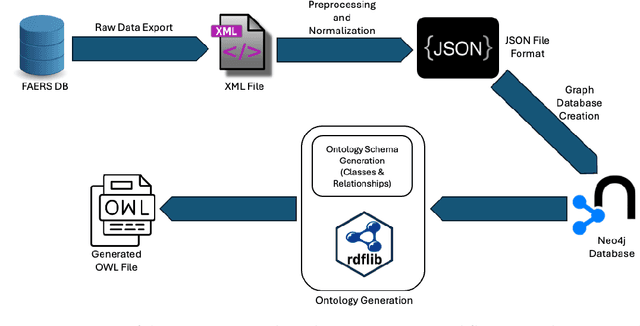
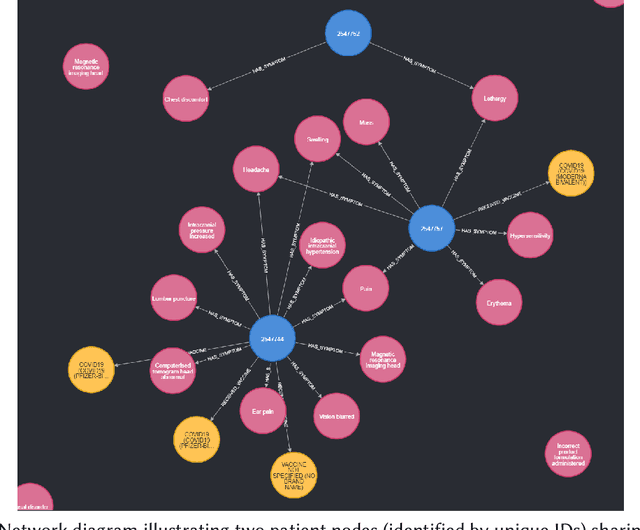
As data and knowledge expand rapidly, adopting systematic methodologies for ontology generation has become crucial. With the daily increases in data volumes and frequent content changes, the demand for databases to store and retrieve information for the creation of knowledge graphs has become increasingly urgent. The previously established Knowledge Acquisition and Representation Methodology (KNARM) outlines a systematic approach to address these challenges and create knowledge graphs. However, following this methodology highlights the existing challenge of seamlessly integrating Neo4j databases with the Web Ontology Language (OWL). Previous attempts to integrate data from Neo4j into an ontology have been discussed, but these approaches often require an understanding of description logics (DL) syntax, which may not be familiar to many users. Thus, a more accessible method is necessary to bridge this gap. This paper presents a user-friendly approach that utilizes Python and its rdflib library to support ontology development. We showcase our novel approach through a Neo4j database we created by integrating data from the Food and Drug Administration (FDA) Adverse Event Reporting System (FAERS) database. Using this dataset, we developed a Python script that automatically generates the required classes and their axioms, facilitating a smoother integration process. This approach offers a practical solution to the challenges of ontology generation in the context of rapidly growing adverse drug event datasets, supporting improved drug safety monitoring and public health decision-making.
GraphRAG-Causal: A novel graph-augmented framework for causal reasoning and annotation in news
Jun 13, 2025GraphRAG-Causal introduces an innovative framework that combines graph-based retrieval with large language models to enhance causal reasoning in news analysis. Traditional NLP approaches often struggle with identifying complex, implicit causal links, especially in low-data scenarios. Our approach addresses these challenges by transforming annotated news headlines into structured causal knowledge graphs. It then employs a hybrid retrieval system that merges semantic embeddings with graph-based structural cues leveraging Neo4j to accurately match and retrieve relevant events. The framework is built on a three-stage pipeline: First, during Data Preparation, news sentences are meticulously annotated and converted into causal graphs capturing cause, effect, and trigger relationships. Next, the Graph Retrieval stage stores these graphs along with their embeddings in a Neo4j database and utilizes hybrid Cypher queries to efficiently identify events that share both semantic and structural similarities with a given query. Finally, the LLM Inference stage utilizes these retrieved causal graphs in a few-shot learning setup with XML-based prompting, enabling robust classification and tagging of causal relationships. Experimental evaluations demonstrate that GraphRAG-Causal achieves an impressive F1-score of 82.1% on causal classification using just 20 few-shot examples. This approach significantly boosts accuracy and consistency, making it highly suitable for real-time applications in news reliability assessment, misinformation detection, and policy analysis.
Managing FAIR Knowledge Graphs as Polyglot Data End Points: A Benchmark based on the rdf2pg Framework and Plant Biology Data
May 23, 2025Linked Data and labelled property graphs (LPG) are two data management approaches with complementary strengths and weaknesses, making their integration beneficial for sharing datasets and supporting software ecosystems. In this paper, we introduce rdf2pg, an extensible framework for mapping RDF data to semantically equivalent LPG formats and data-bases. Utilising this framework, we perform a comparative analysis of three popular graph databases - Virtuoso, Neo4j, and ArcadeDB - and the well-known graph query languages SPARQL, Cypher, and Gremlin. Our qualitative and quantitative as-sessments underline the strengths and limitations of these graph database technologies. Additionally, we highlight the potential of rdf2pg as a versatile tool for enabling polyglot access to knowledge graphs, aligning with established standards of Linked Data and the Semantic Web.
MRM3: Machine Readable ML Model Metadata
May 19, 2025As the complexity and number of machine learning (ML) models grows, well-documented ML models are essential for developers and companies to use or adapt them to their specific use cases. Model metadata, already present in unstructured format as model cards in online repositories such as Hugging Face, could be more structured and machine readable while also incorporating environmental impact metrics such as energy consumption and carbon footprint. Our work extends the existing State of the Art by defining a structured schema for ML model metadata focusing on machine-readable format and support for integration into a knowledge graph (KG) for better organization and querying, enabling a wider set of use cases. Furthermore, we present an example wireless localization model metadata dataset consisting of 22 models trained on 4 datasets, integrated into a Neo4j-based KG with 113 nodes and 199 relations.
D4R -- Exploring and Querying Relational Graphs Using Natural Language and Large Language Models -- the Case of Historical Documents
Mar 26, 2025D4R is a digital platform designed to assist non-technical users, particularly historians, in exploring textual documents through advanced graphical tools for text analysis and knowledge extraction. By leveraging a large language model, D4R translates natural language questions into Cypher queries, enabling the retrieval of data from a Neo4J database. A user-friendly graphical interface allows for intuitive interaction, enabling users to navigate and analyse complex relational data extracted from unstructured textual documents. Originally designed to bridge the gap between AI technologies and historical research, D4R's capabilities extend to various other domains. A demonstration video and a live software demo are available.
SynthCypher: A Fully Synthetic Data Generation Framework for Text-to-Cypher Querying in Knowledge Graphs
Dec 17, 2024
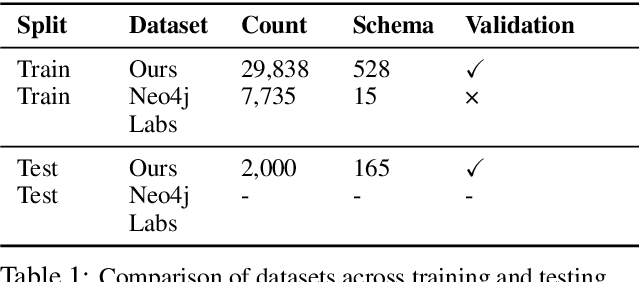
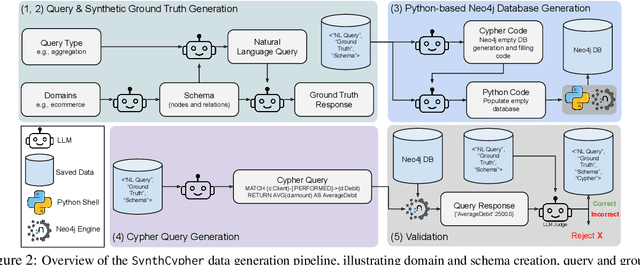
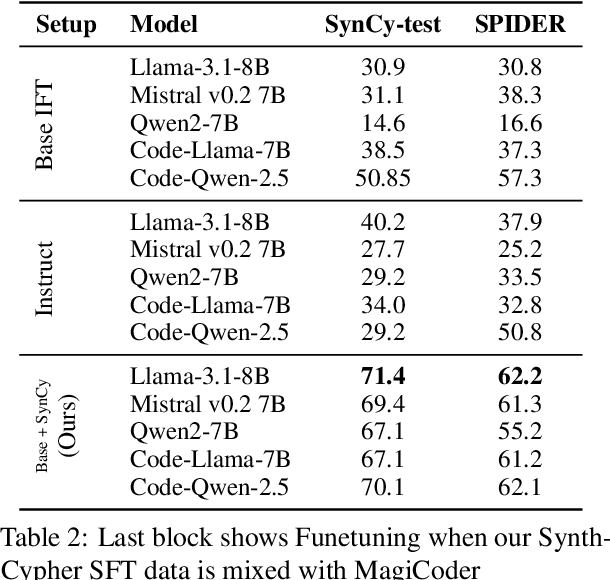
Cypher, the query language for Neo4j graph databases, plays a critical role in enabling graph-based analytics and data exploration. While substantial research has been dedicated to natural language to SQL query generation (Text2SQL), the analogous problem for graph databases referred to as Text2Cypher remains underexplored. In this work, we introduce SynthCypher, a fully synthetic and automated data generation pipeline designed to address this gap. SynthCypher employs a novel LLMSupervised Generation-Verification framework, ensuring syntactically and semantically correct Cypher queries across diverse domains and query complexities. Using this pipeline, we create SynthCypher Dataset, a large-scale benchmark containing 29.8k Text2Cypher instances. Fine-tuning open-source large language models (LLMs), including LLaMa-3.1- 8B, Mistral-7B, and QWEN-7B, on SynthCypher yields significant performance improvements of up to 40% on the Text2Cypher test set and 30% on the SPIDER benchmark adapted for graph databases. This work demonstrates that high-quality synthetic data can effectively advance the state-of-the-art in Text2Cypher tasks.
Combining knowledge graphs and LLMs for hazardous chemical information management and reuse
Dec 10, 2024Human health is increasingly threatened by exposure to hazardous substances, particularly persistent and toxic chemicals. The link between these substances, often encountered in complex mixtures, and various diseases are demonstrated in scientific studies. However, this information is scattered across several sources and hardly accessible by humans and machines. This paper evaluates current practices for publishing/accessing information on hazardous chemicals and proposes a novel platform designed to facilitate retrieval of critical chemical data in urgent situations. The platform aggregates information from multiple sources and organizes it into a structured knowledge graph. Users can access this information through a visual interface such as Neo4J Bloom and dashboards, or via natural language queries using a Chatbot. Our findings demonstrate a significant reduction in the time and effort required to access vital chemical information when datasets follow FAIR principles. Furthermore, we discuss the lessons learned from the development and implementation of this platform and provide recommendations for data owners and publishers to enhance data reuse and interoperability. This work aims to improve the accessibility and usability of chemical information by healthcare professionals, thereby supporting better health outcomes and informed decision-making in the face of patients exposed to chemical intoxication risks.
SM3-Text-to-Query: Synthetic Multi-Model Medical Text-to-Query Benchmark
Nov 08, 2024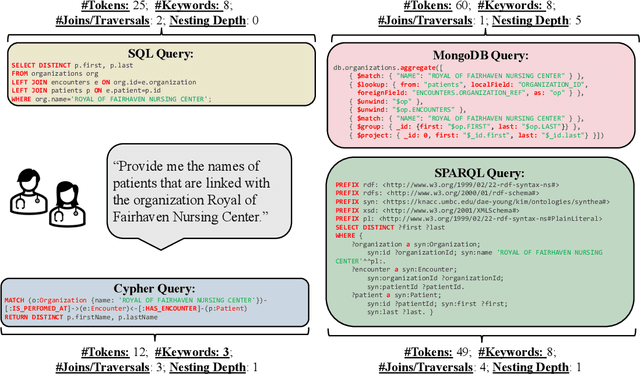

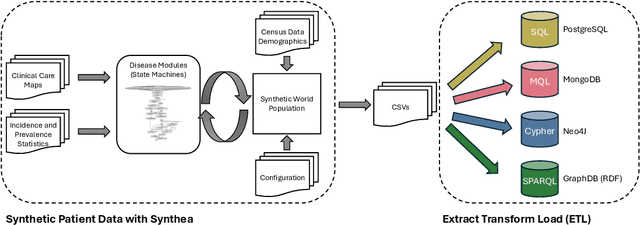

Electronic health records (EHRs) are stored in various database systems with different database models on heterogeneous storage architectures, such as relational databases, document stores, or graph databases. These different database models have a big impact on query complexity and performance. While this has been a known fact in database research, its implications for the growing number of Text-to-Query systems have surprisingly not been investigated so far. In this paper, we present SM3-Text-to-Query, the first multi-model medical Text-to-Query benchmark based on synthetic patient data from Synthea, following the SNOMED-CT taxonomy -- a widely used knowledge graph ontology covering medical terminology. SM3-Text-to-Query provides data representations for relational databases (PostgreSQL), document stores (MongoDB), and graph databases (Neo4j and GraphDB (RDF)), allowing the evaluation across four popular query languages, namely SQL, MQL, Cypher, and SPARQL. We systematically and manually develop 408 template questions, which we augment to construct a benchmark of 10K diverse natural language question/query pairs for these four query languages (40K pairs overall). On our dataset, we evaluate several common in-context-learning (ICL) approaches for a set of representative closed and open-source LLMs. Our evaluation sheds light on the trade-offs between database models and query languages for different ICL strategies and LLMs. Last, SM3-Text-to-Query is easily extendable to additional query languages or real, standard-based patient databases.